Manual · Feature Tour

See everything it does
before you download.

A page-by-page walkthrough of the whole plugin — every screenshot is from the live app. The player is free forever; the Pro features and preset packs are marked as we go.

Getting started Interface Amp Pedalboard EQ Multiband comp Cabinet Time FX Capture studio Library & TONE3000 Dual rig Presets & packs

1 · Getting started

Installed and playing in two minutes

One signed installer per platform — Windows (VST3 + Standalone) and macOS 11+ (AU + VST3 + Standalone, one universal build for Apple Silicon & Intel). No account, no activation — the player is free forever.

  1. Run the installer and choose your formats. Both are digitally signed — Authenticode on Windows, notarized by Apple on macOS — so they install cleanly, no warnings to bypass.
  2. On first launch it fills your library with starter presets, amp profiles, the boost-pedal captures and a factory cabinet — so it makes sound immediately.
  3. In a DAW, drop NAM 9000 on a guitar track — VST3, or AU in Logic and GarageBand. Standalone? Pick your audio interface in Options and play.
  4. Set Input so the meter sits healthy, pick a preset, and go.

The interface renders through the system webview — Microsoft Edge WebView2 on Windows (ships with Windows 11 and current Windows 10; the installer links the free download if it's ever missing) and WKWebView on macOS, which is built into the OS. Nothing extra to install on a Mac.

2 · The interface

One window, a row of pages

A top toolbar of global controls, a page for each part of the rig, and a bottom bar of utilities. The whole UI is vector art, so it stays razor-sharp at any size.

Always visible

3 · The amp

Any neural capture, fully gain-staged

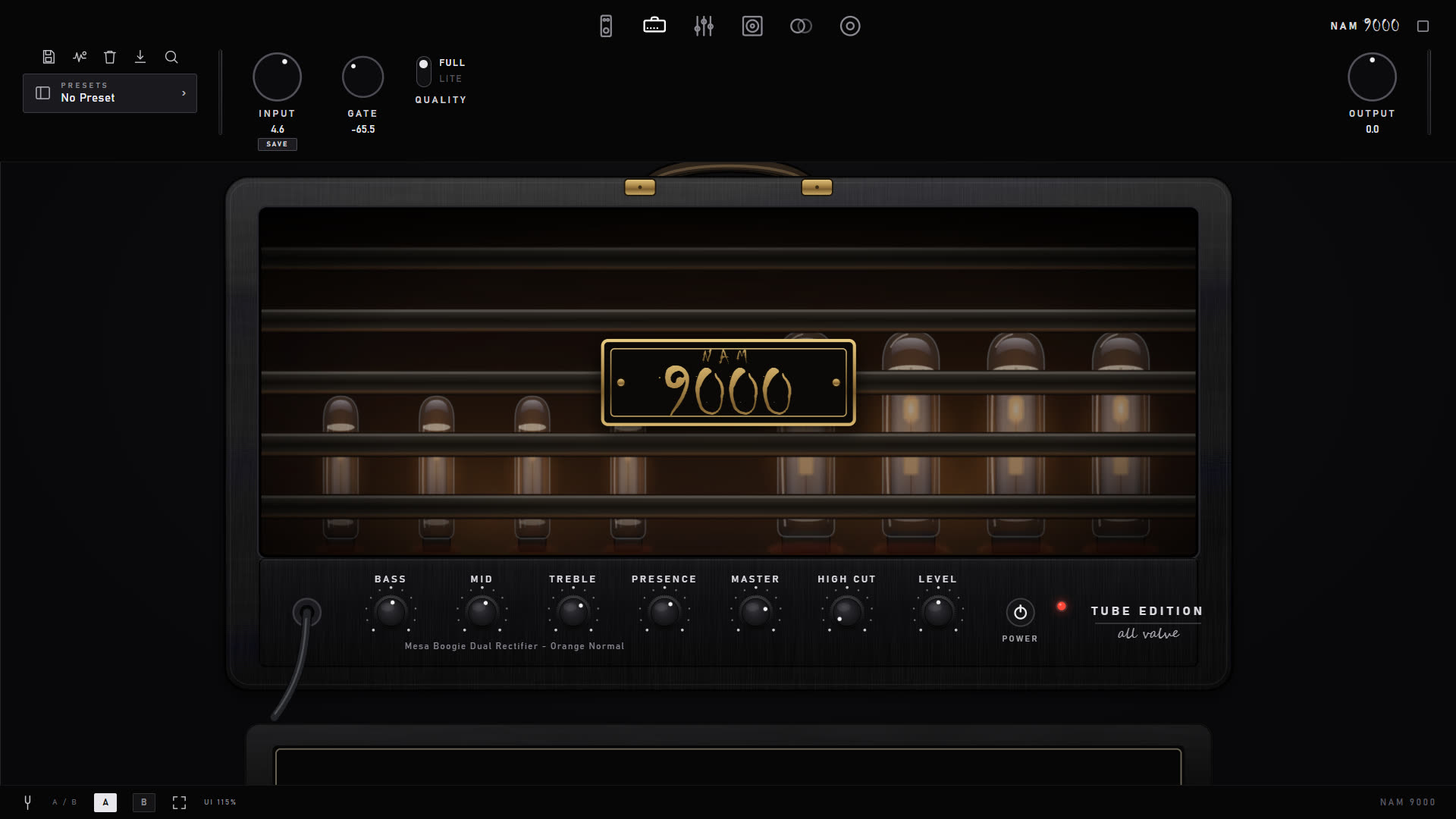
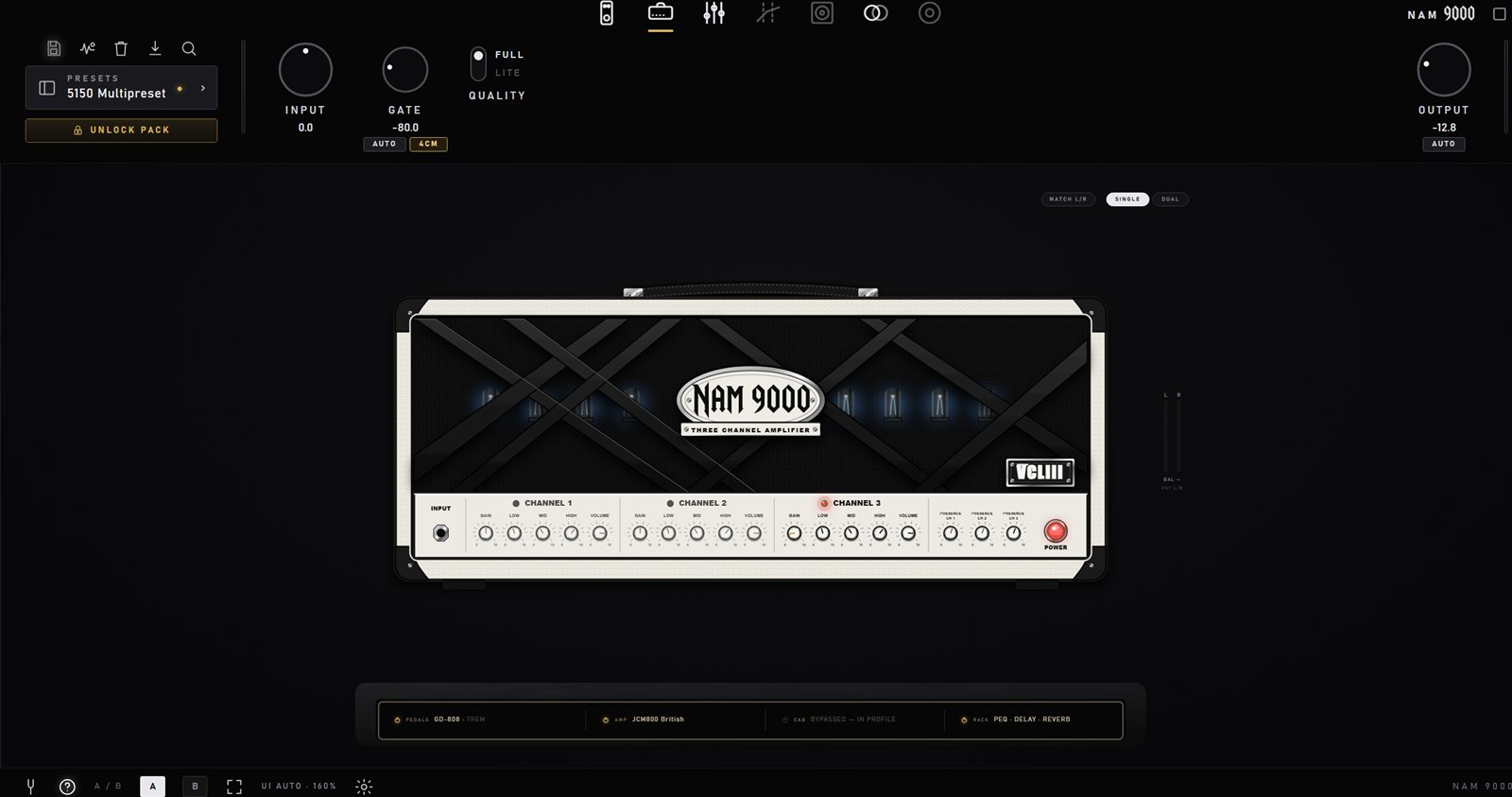
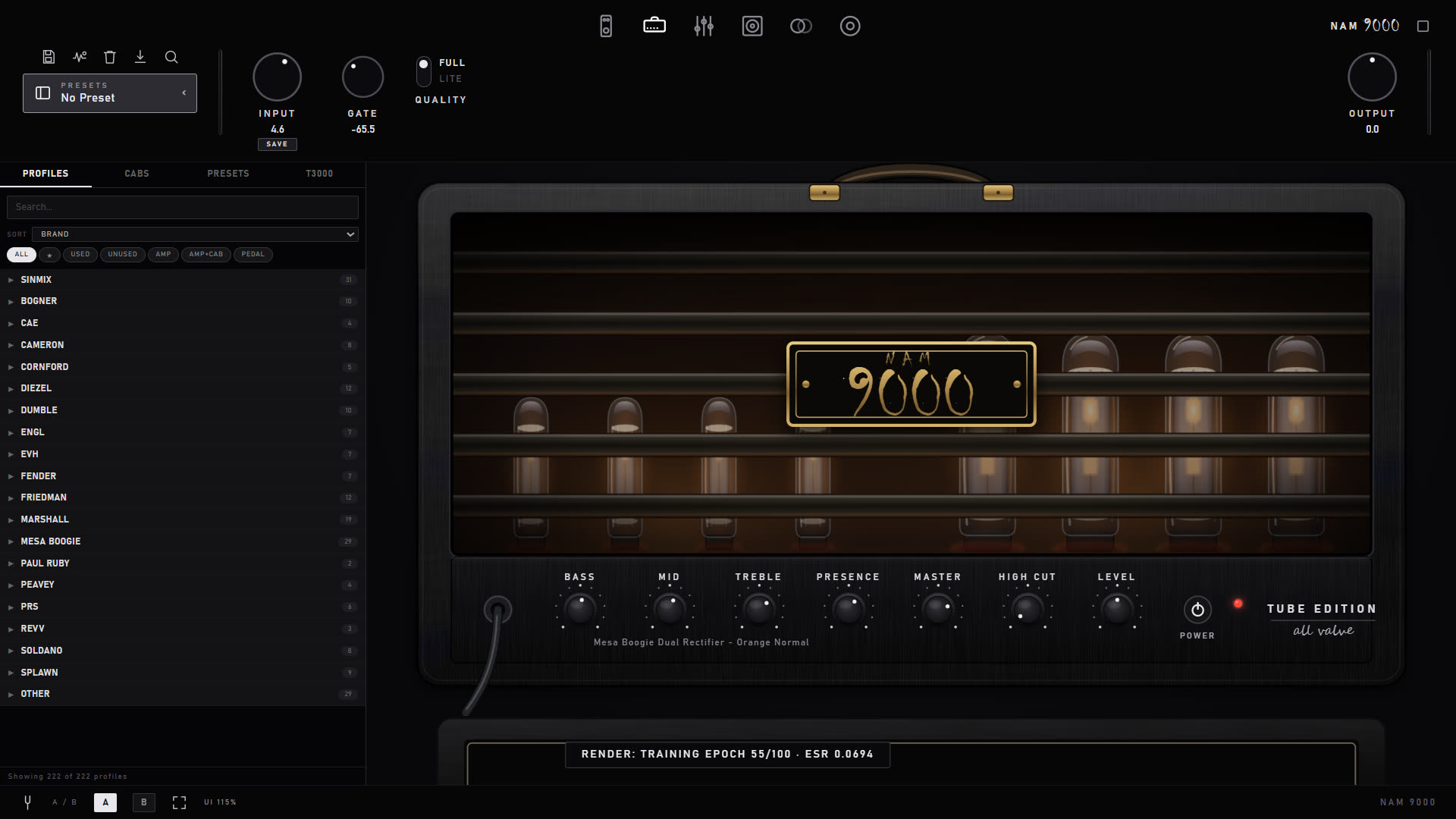
The heart of the rig. Load any standard .nam profile — from the built-in library, TONE3000, a preset pack, or your own captures — and dial it in on a real amp panel.

The amp page
The amp page — profile name shown under the tone stack.

4 · The pedalboard

A reorderable stomp chain

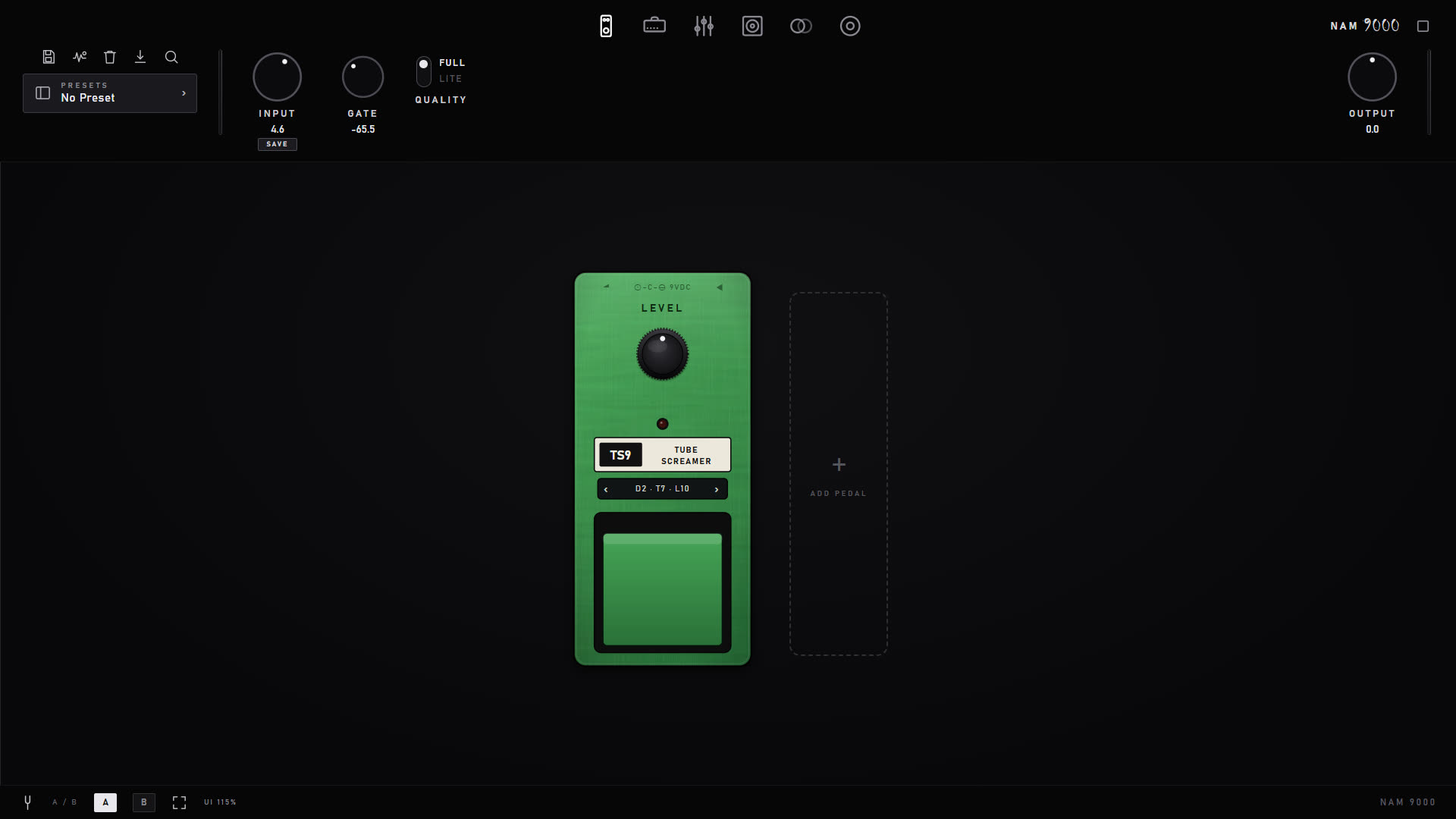
Drag pedals into the order you want. A compressor, a tube-screamer boost, a dedicated slot for a captured pedal, plus pitch, phaser, flanger, tremolo and chorus.

The pedalboard page
The pedalboard — drag to reorder; each pedal engages and bypasses with a click.

5 · Studio EQ

A graphic and a parametric — at the same time

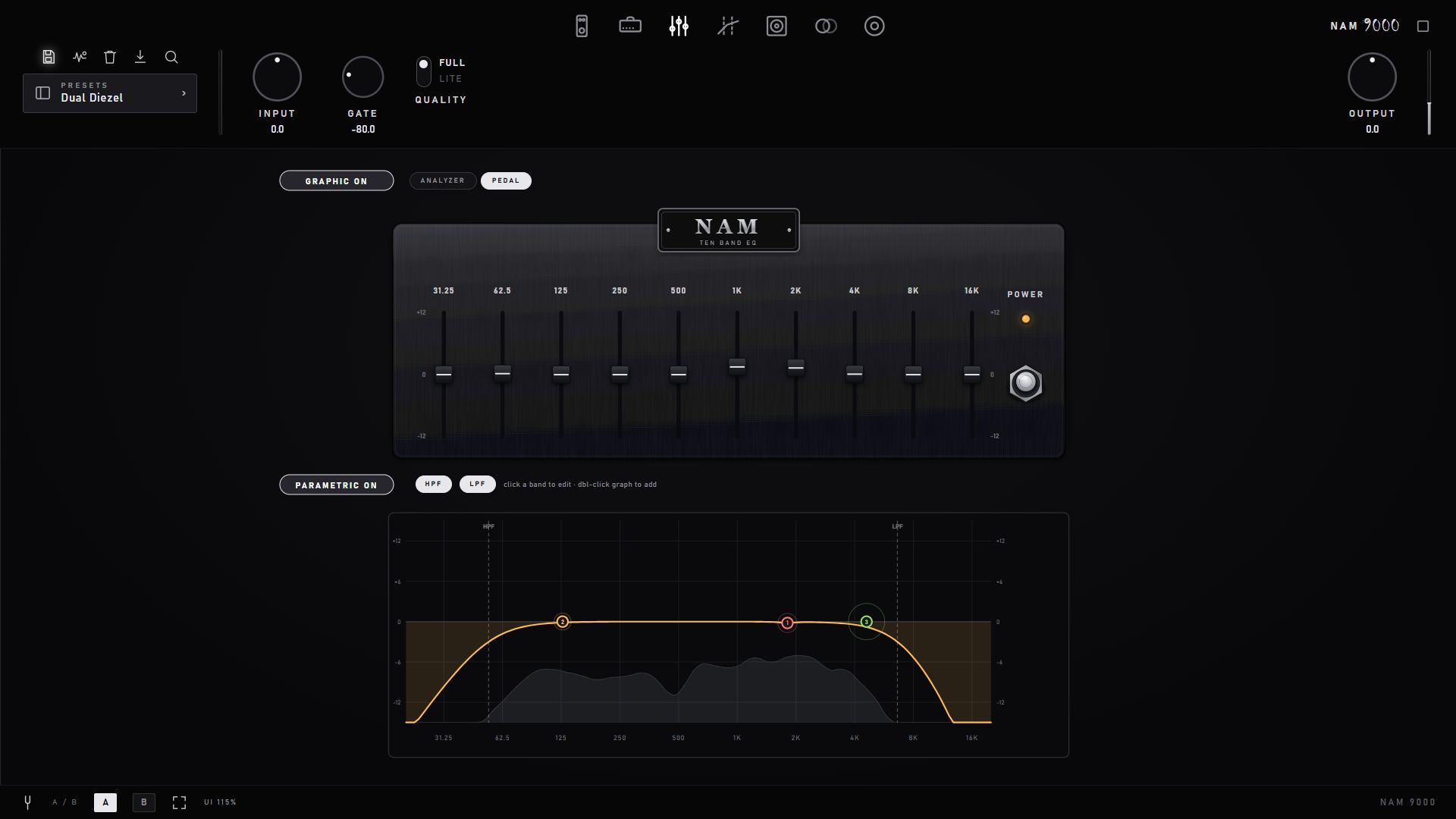
Two independent EQ panels with live analyzers: a 10-band graphic rack unit and an 8-band parametric, both usable at once for surgical and broad shaping.

The EQ page
The parametric EQ on its live analyzer.

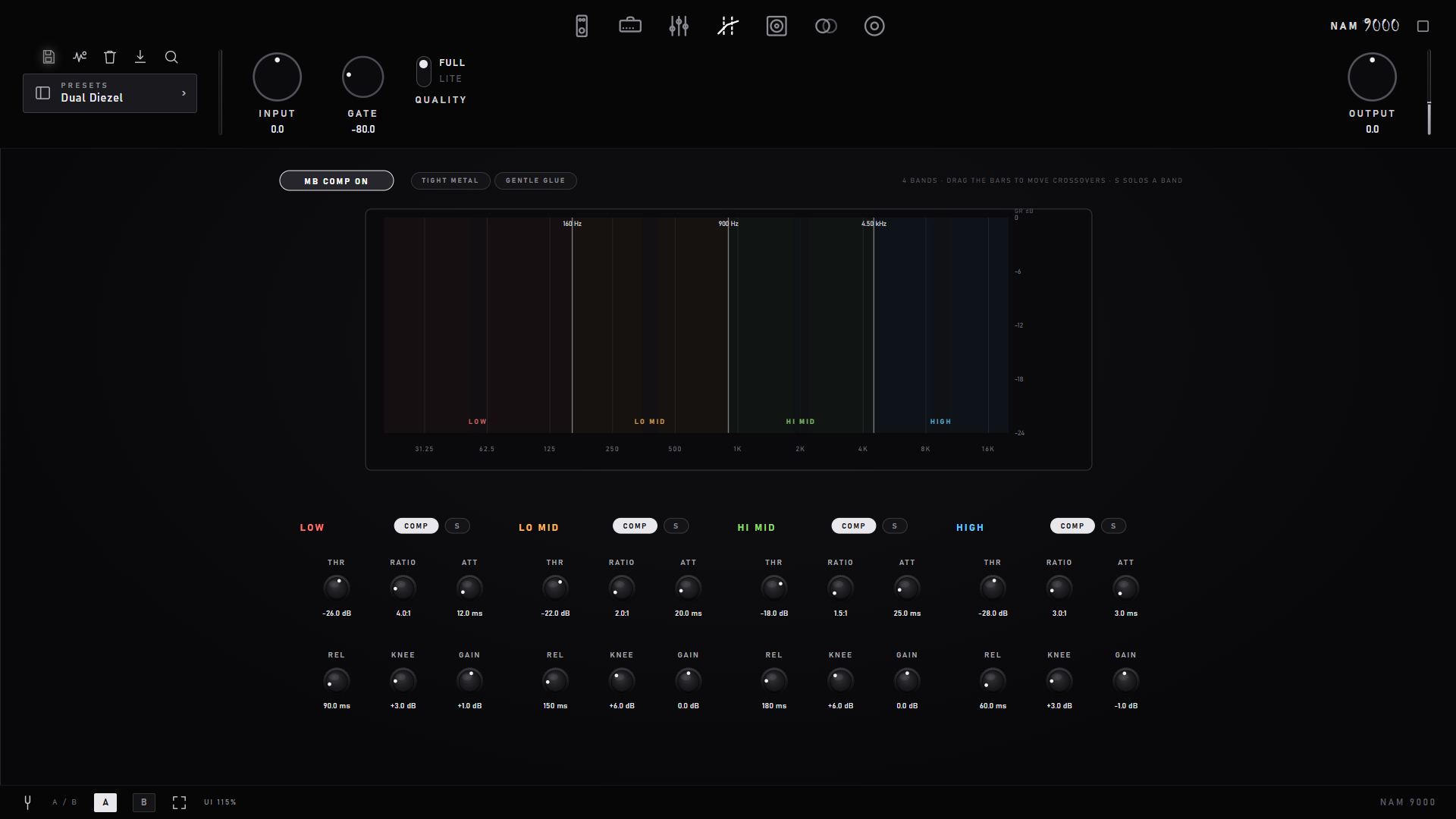
6 · Multiband compressor PRO

The metal-mixing weapon

Four crossover bands, each with its own compressor and gain-reduction meter — tighten low-end chug without dulling the top, all inside the plugin.

The multiband compressor page
Four-band multiband compressor with per-band GR metering.

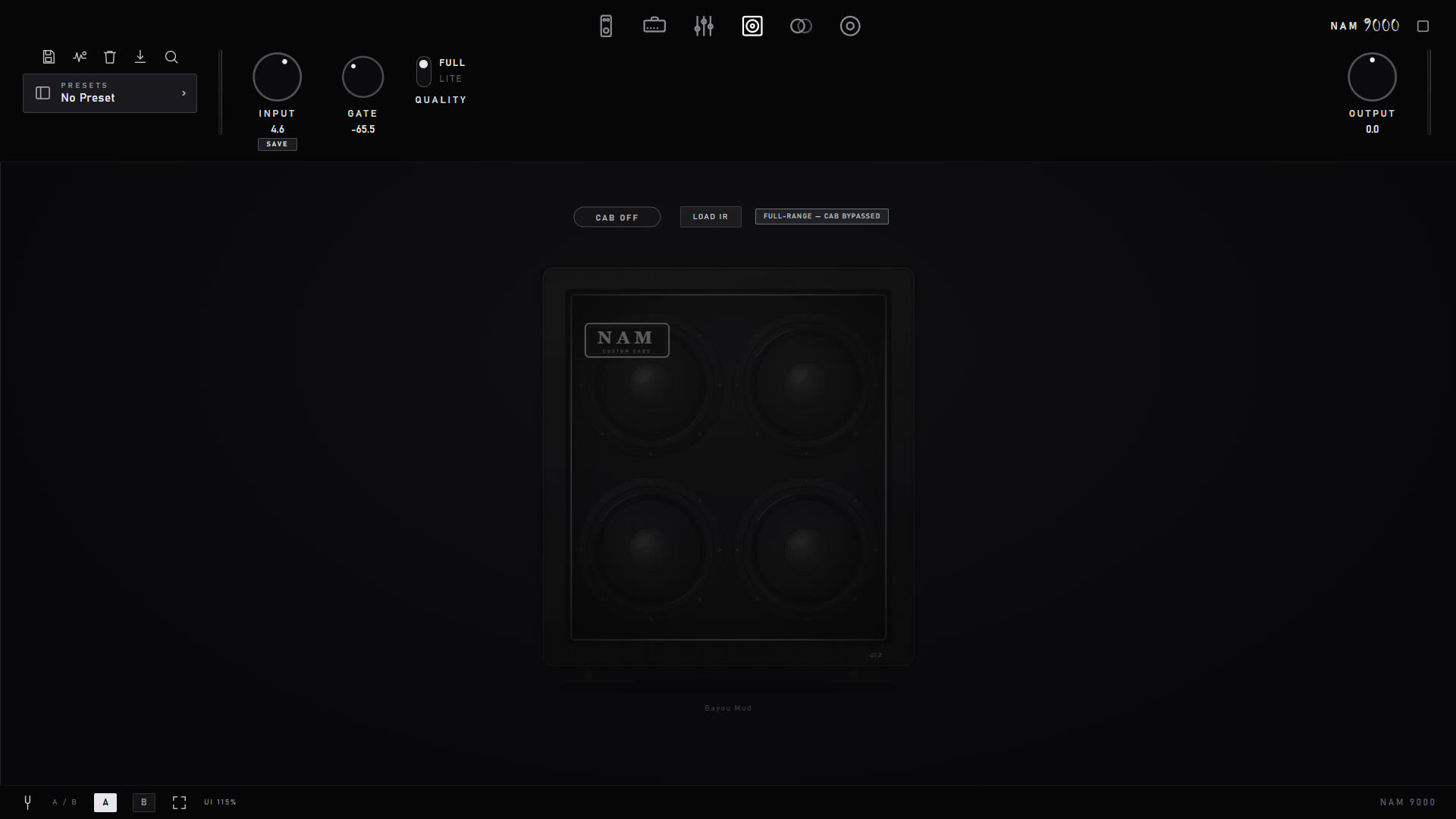
7 · Cabinet

Real impulse-response convolution

Load any .wav IR, or the factory blended-speaker cabinet. IRs are loudness-normalized on the guitar band so swapping a cab changes tone, not level.

The cabinet page
The cabinet page — single IR, or the Pro dual-mic blend.

8 · Time FX

Delay and reverb to finish the chain

Post-cab time effects: a multi-mode delay with tempo sync, and a reverb — the last stage before your rig is a mix-ready channel.

9 · Capture & training studio

Clone your own gear

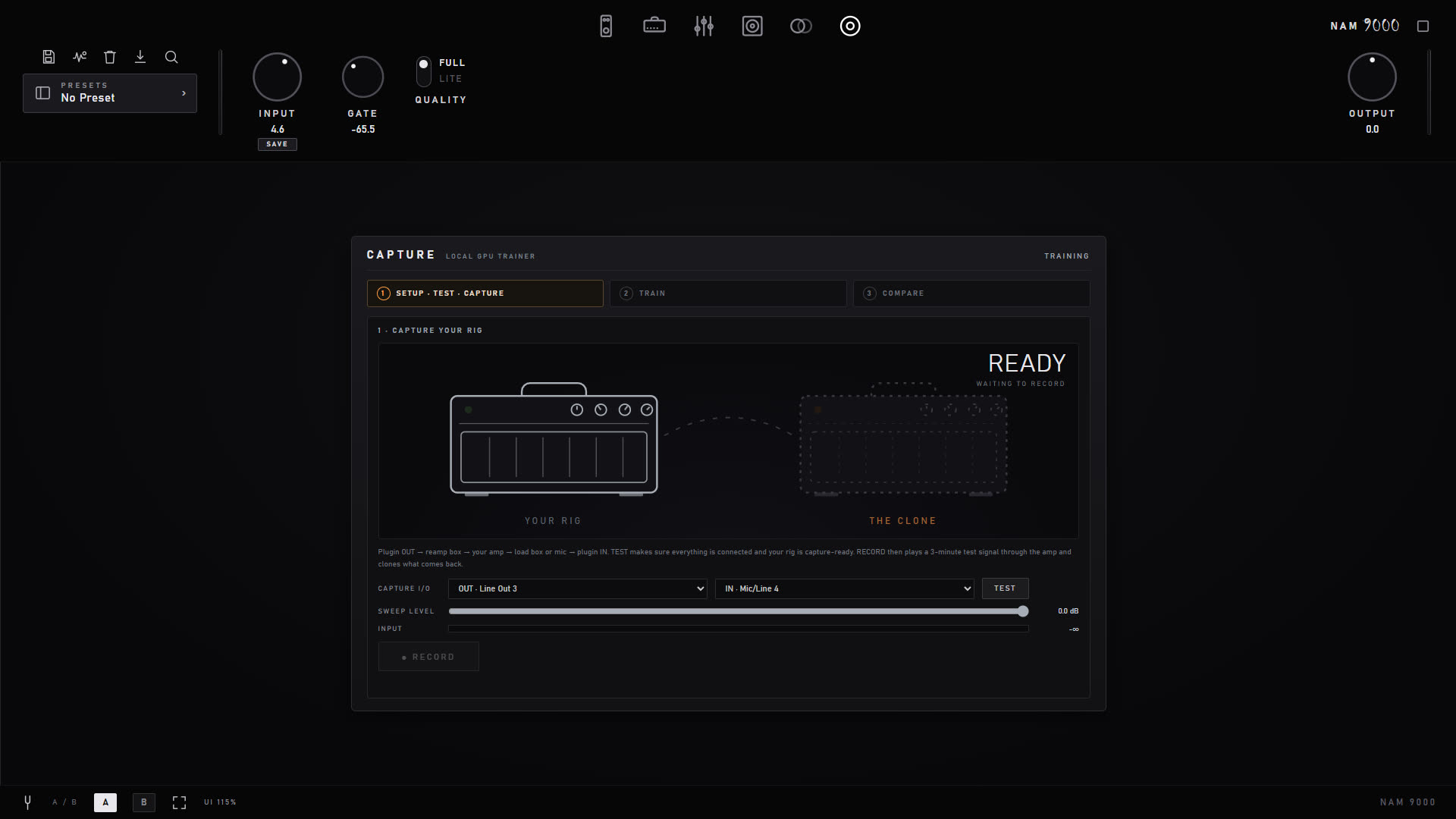
Built-in profiler: play a test signal through your amp, pedal or whole rig and train a neural model of it — on your own NVIDIA GPU on Windows, or free in the cloud on Mac (and on any machine without an NVIDIA card). No separate software.

The capture studio page
The capture studio — a guided clone / test / train / compare flow.
  1. Test checks your connection, latency, noise floor and repeatability so you know the capture will be clean before you commit.
  2. Record plays a ~3-minute sweep through your rig and captures the return, with live progress.
  3. Train builds the model on your GPU; the match quality (ESR) is reported so you know it's good.
  4. Compare A/Bs the clone against the real thing.

Captures of your own gear export to NAM-compatible hardware (Dimehead, HoTone, Darkglass and others) as a standard .nam — free, no strings.

No NVIDIA GPU? Train in the cloud

Local training needs an NVIDIA GPU — but you don't need one to capture. Record the sweep as usual, then hit Export for TONE3000: the app saves your recording alongside the standard input file and opens tone3000.com/train, where you upload both and train in the browser for free. Download the finished .nam and load it straight back into NAM 9000. Same capture, no graphics card required — it's the recommended path on machines without an NVIDIA GPU, and the standard path on macOS.

10 · Library & TONE3000

Thousands of tones, one click away

A browser for your profiles, cabs and presets — searchable, folder-organized, sortable — plus the TONE3000 library built right in.

The profile browser
The profile browser — search, sort, group, and audition.

11 · Dual rig PRO

Two full amps, two cabs, one plugin

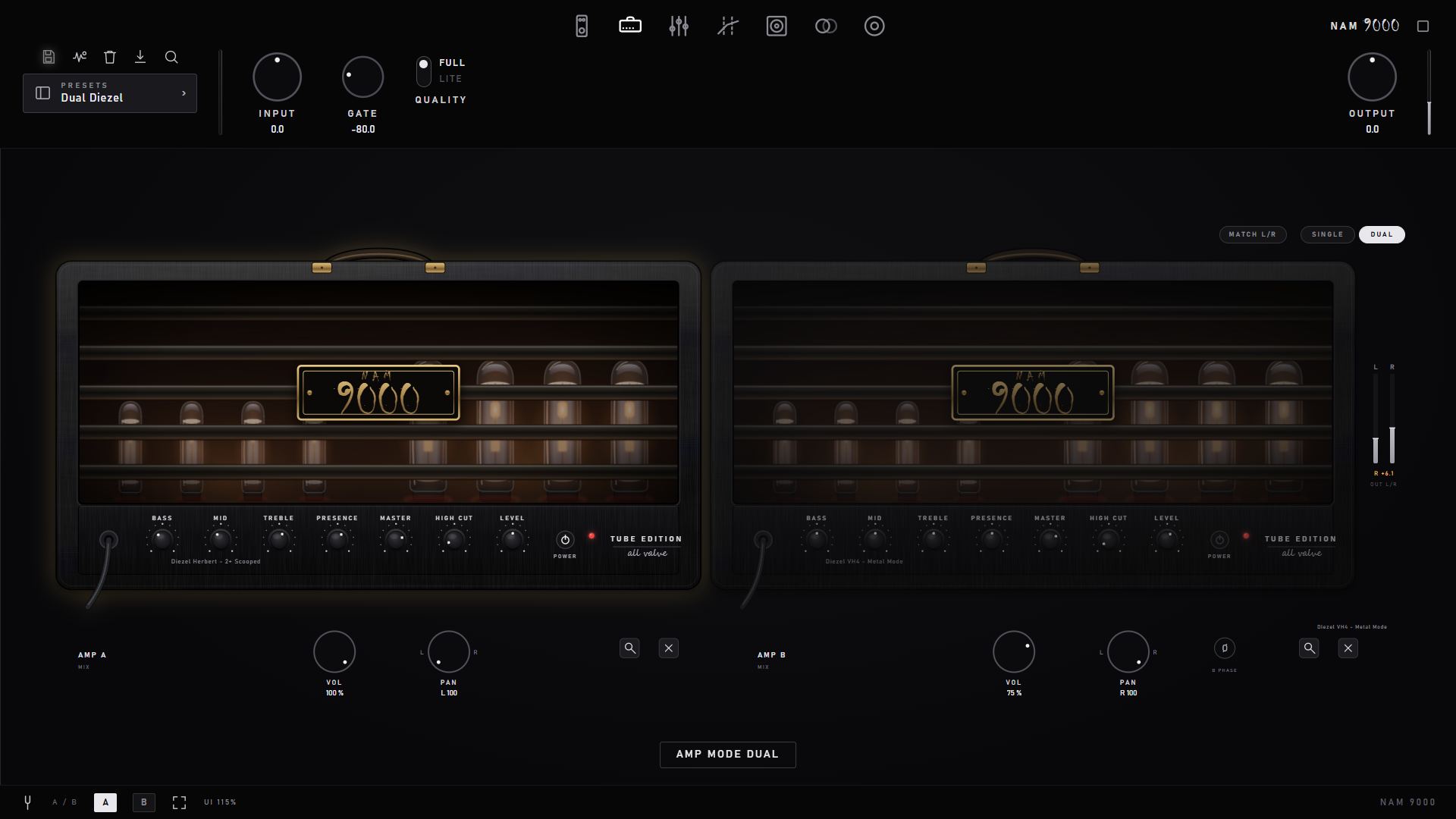
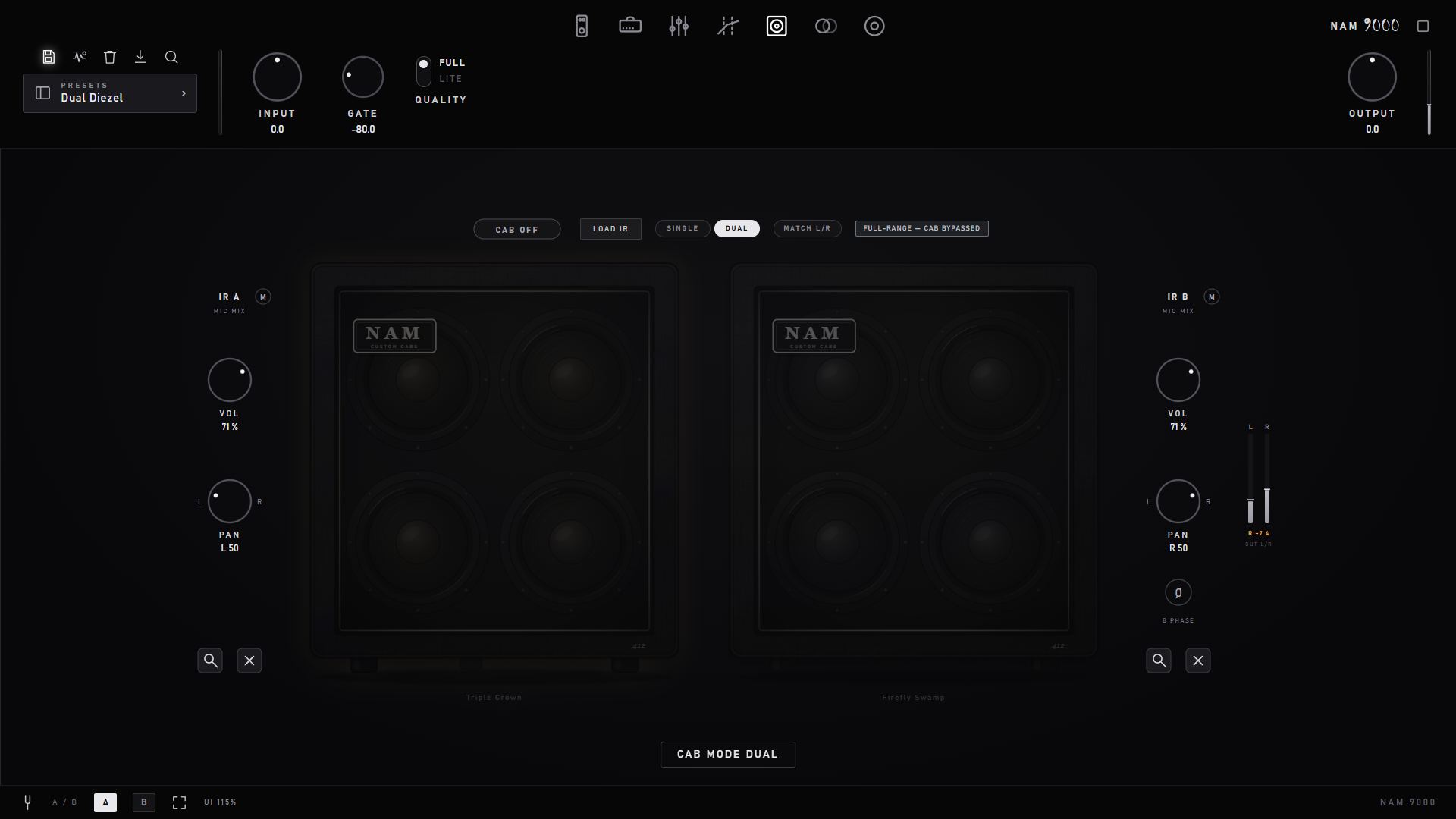
Run two independent amp captures in parallel, each with its own mix panel, and blend two cabs — a two-mic blend on one amp, or a full cab per amp.

Dual amp rig
Dual amp rig — a level/pan/phase mixer under each head.
Dual cabinet
Dual cab — two-mic IR blend with per-mic level, pan and phase.

The plugin is mono-in by design; the stereo image is created intentionally inside the box. Engaging dual mode pans the two amps hard left and right by default — the right way to run a dual rig (a wide, dimensional tone, each amp on its own side). Summing two amps to the centre instead phase-cancels the low end, so the plugin warns you if both land near centre or if the two captures have different native sample rates.

Why a dual rig is panned, never summed — the measurements

Two nonlinear amp captures must never be summed onto one channel. We measured it on the real audio engine (the internal DspProbe --dual harness, driving the actual mixer with noise and reading back the spectrum) and found two independent things go wrong when two amps share a channel:

Panned hard left and right, neither mechanism can fire: each amp lands on its own channel, so there is nothing to cancel or comb against. Measured that way each side is identical to that amp running solo (0.0 dB difference across the spectrum) — the second amp adds stereo width and depth, not a tonal fight. That is why the plugin spreads the amps hard L/R the instant you go dual, nudges you with a warning if they drift back toward centre, and — as below — renders a dual amp rig to two separate files rather than one blend.

Render Rig — what a dual rig exports

Render Rig bakes the live rig into a standard .nam. Because a .nam is mono in and out, what it writes depends on the rig:

IR alignment — automatic, plus a fine trim

Blending two IRs has its own classic failure mode: every IR carries its own leading dead time (mic distance, processing padding), and two IRs whose impulses don't land at the same instant comb-filter when summed — the same hollow sound, from the cab side. Hardware modelers ship an "align" control in their cab blocks for exactly this reason.

NAM 9000 handles it in two layers:

If a blend still thins out, the per-mic phase button (Ø) flips polarity — alignment fixes timing, Ø fixes polarity; together they cover both ways two mics can fight. All of it applies before Render Rig bakes a blend, so exported profiles are phase-true too.

12 · Presets & packs

Save your own, or start from ours

A preset stores the whole rig — every pedal, the amp, both EQs, the cab and the time FX — as one recallable channel strip. Share them as bundles, or unlock curated packs.

Preset packs

Optional paid packs add curated, mix-ready tones. Each pack ships every amp twice — the finished full rig (cab baked in) and an amp-only "DI" profile to pair with your own cab or IR. Unlocking is fully offline: paste your license key into the in-app Unlock dialog. No account, no activation server.